
When someone asks ChatGPT “who’s the best web design agency near me?” or asks Perplexity “how much does SEO cost?”, the AI answers with a short response and a handful of cited sources. Being one of those sources is the new page-one ranking. This guide shows you exactly how to get cited by ChatGPT, Perplexity, and Google’s AI Overviews — the discipline often called generative engine optimization (GEO).
None of this requires tricks. Learning how to get cited by ChatGPT simply rewards the businesses that make their expertise easy for a machine to find, read, and trust.
ChatGPT serves hundreds of millions of users each month, Perplexity has made cited answers its core product, and Google’s AI Overviews now appear on the majority of searches. Gartner has forecast that these habits will pull a large slice of volume away from classic search. Because generative AI tools built on large language models now sit between your business and the customer, being their cited source is the new front page. In short, a growing number of buying decisions start — and sometimes end — inside an AI answer. If your competitors are cited there and you are not, they win the customer before you are even considered.
Answer engines look for sources that are easy to extract and safe to trust. In practice that means three things: content they can read cleanly (clear structure and schema), content they can trust (authority, consistency, real expertise), and content that directly answers the question (an answer-first block they can lift). Get those three right and you dramatically raise your odds of being quoted. This overlaps heavily with classic search engine optimization — see AEO vs SEO for how the two connect.
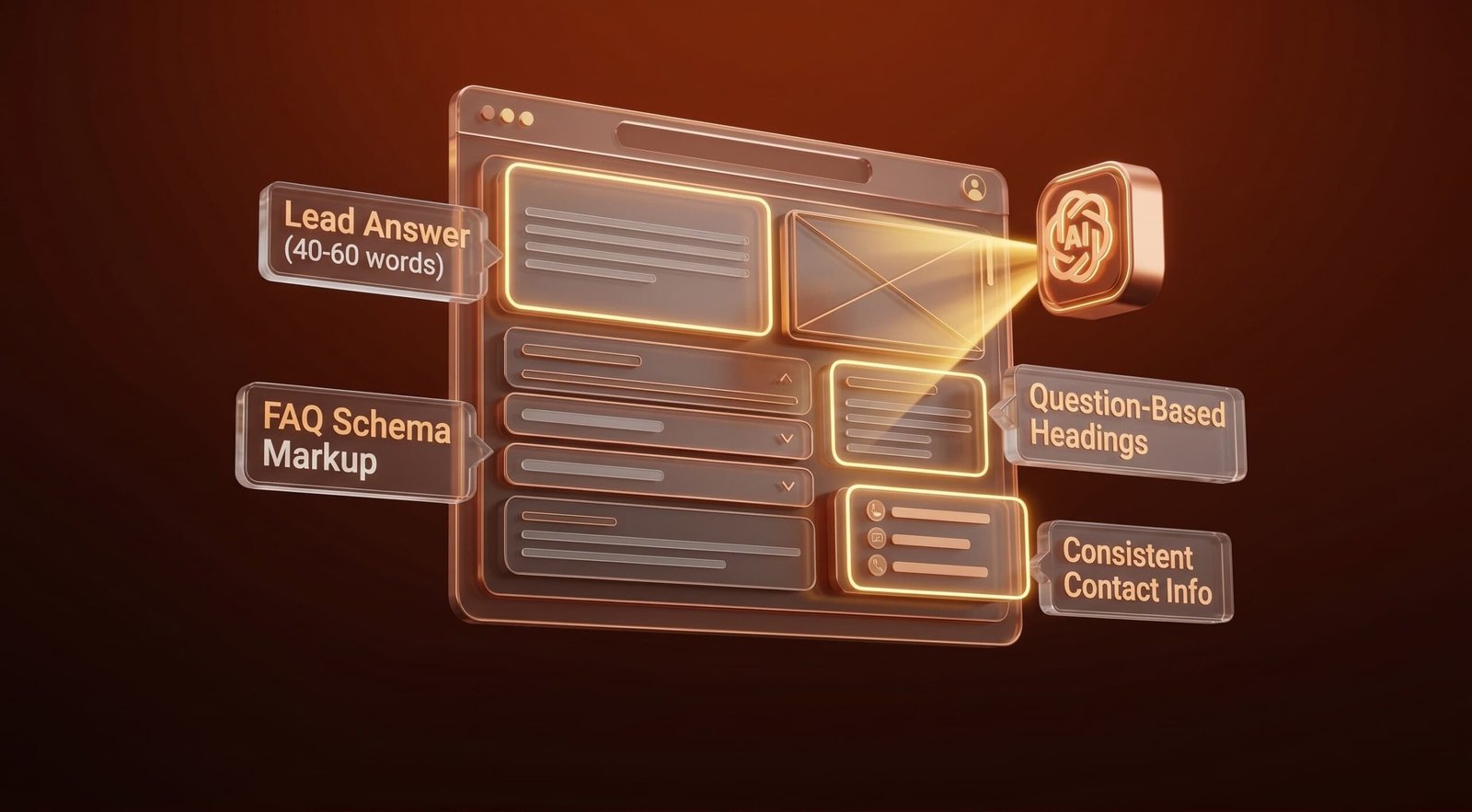
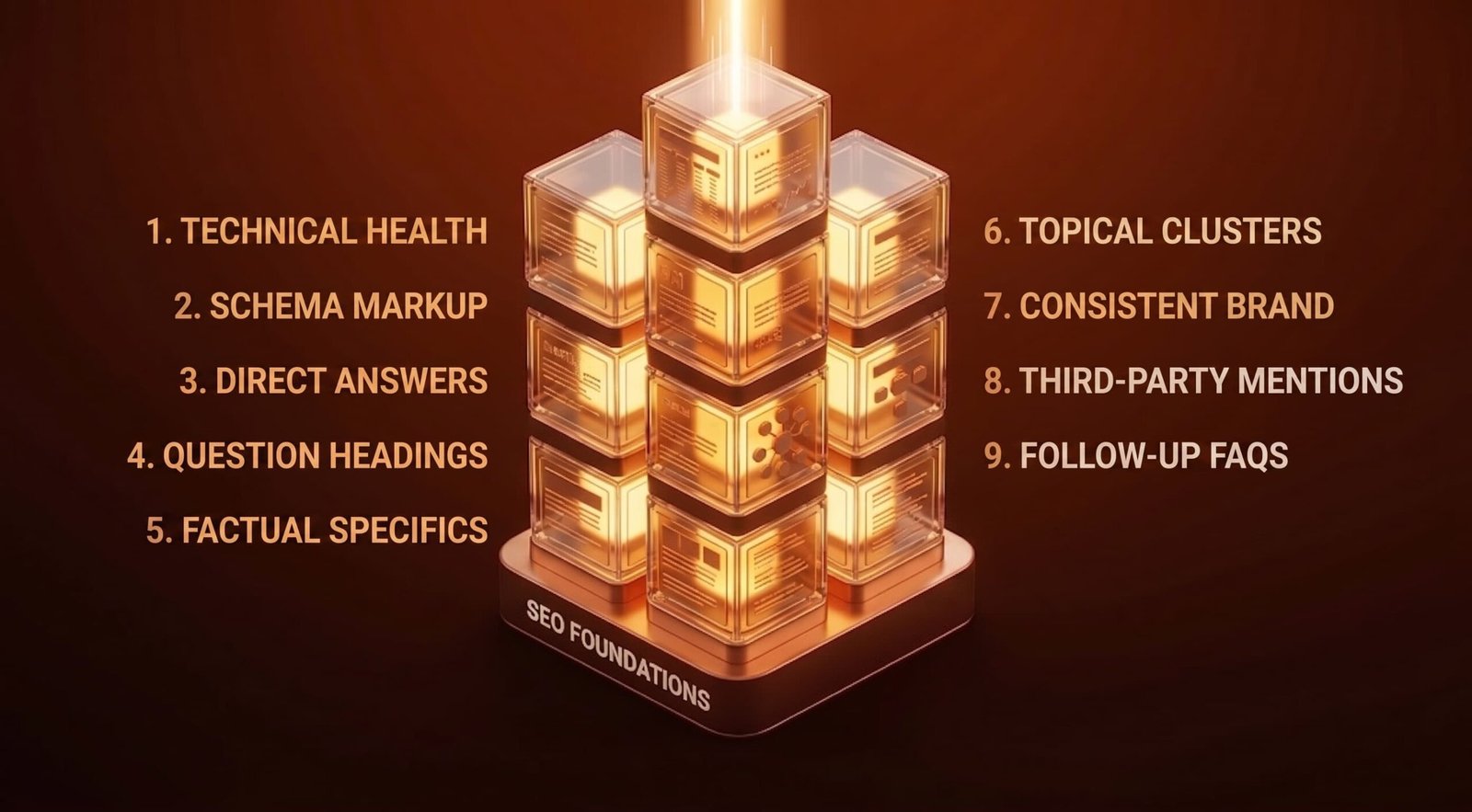
9 ways to get cited by ChatGPT and Perplexity
1. Lead with a direct, quotable answer
Open every important page with a self-contained 40–60 word answer to the main question. This is the block AI is most likely to lift. Everything else on the page supports it.
2. Add structured data
Mark up your content with Schema.org types — Organization, Article, FAQ, and Product where relevant. Structured data tells machines exactly what your content means. Most sites still skip it, which is precisely why it works so well. Google’s Search Central documents the supported types.
3. Use question-based headings
Write headings the way people ask questions out loud. “How much does a website cost?” beats “Pricing.” This matches your content to conversational queries word for word.
4. Be specific and factual
Use real numbers, dates, named services and clear comparisons. AI engines prefer concrete facts they can quote with confidence over vague marketing language.
5. Build topical authority with clusters
Publish a connected set of posts around one theme rather than scattered one-offs. A tight cluster signals genuine expertise. Our own AI cluster — webMCP, AI agents vs chatbots, and answer engine optimization — is built exactly this way.
5. Build topical authority with clusters
Publish a connected set of posts around one theme rather than scattered one-offs. A tight cluster signals genuine expertise. Our own AI cluster — webMCP, AI agents vs chatbots, and answer engine optimization — is built exactly this way.
6. Earn mentions on trusted third-party sites
AI engines cross-check your brand against the wider web. Guest articles, directory listings, reviews, and press mentions all build the trust signals that make you citation-worthy. Consistency across those sources matters as much as quantity.
7. Keep your brand information consistent everywhere
Your name, services, and contact details should match across your site, Google Business Profile, LinkedIn and social channels. Conflicting information makes an AI less willing to cite you. If your brand name is sometimes misspelled online, fixing that with correct Organization schema is high-priority.
8. Make the page fast and technically clean
Slow, broken or blocked pages are hard for any crawler to use. If your site struggles here, our guide to why your website is not ranking on Google covers the fixes.
9. Answer the follow-up questions too
Add an FAQ section that covers the natural next questions. This gives AI more quotable blocks and matches the follow-up prompts users type after their first question. The helpful-content guidance from Google rewards this depth as well.
A real example of how a citation happens
Picture a small accounting firm. A prospective client opens Perplexity and asks, “What should a small business look for when hiring an accountant?” Perplexity composes a short answer and lists three cited sources beneath it.
The firm that gets cited did four unglamorous things well. It published a clear guide titled with the exact question people ask. It opened that guide with a tight, self-contained answer. It marked the page up with Article and FAQ schema so Perplexity could parse it cleanly. And it had consistent, trustworthy information across its website, Google Business Profile and LinkedIn. None of that is magic — it is just being the easiest credible source to quote. The two competitors who wrote vague “welcome to our blog” posts were invisible.
That is the real mindset shift behind how to get cited by ChatGPT: you are not writing to impress a reader who is already on your page — you are writing to be liftable by a machine that is deciding, in a fraction of a second, whose words to put in front of a customer.
How this differs from traditional link building
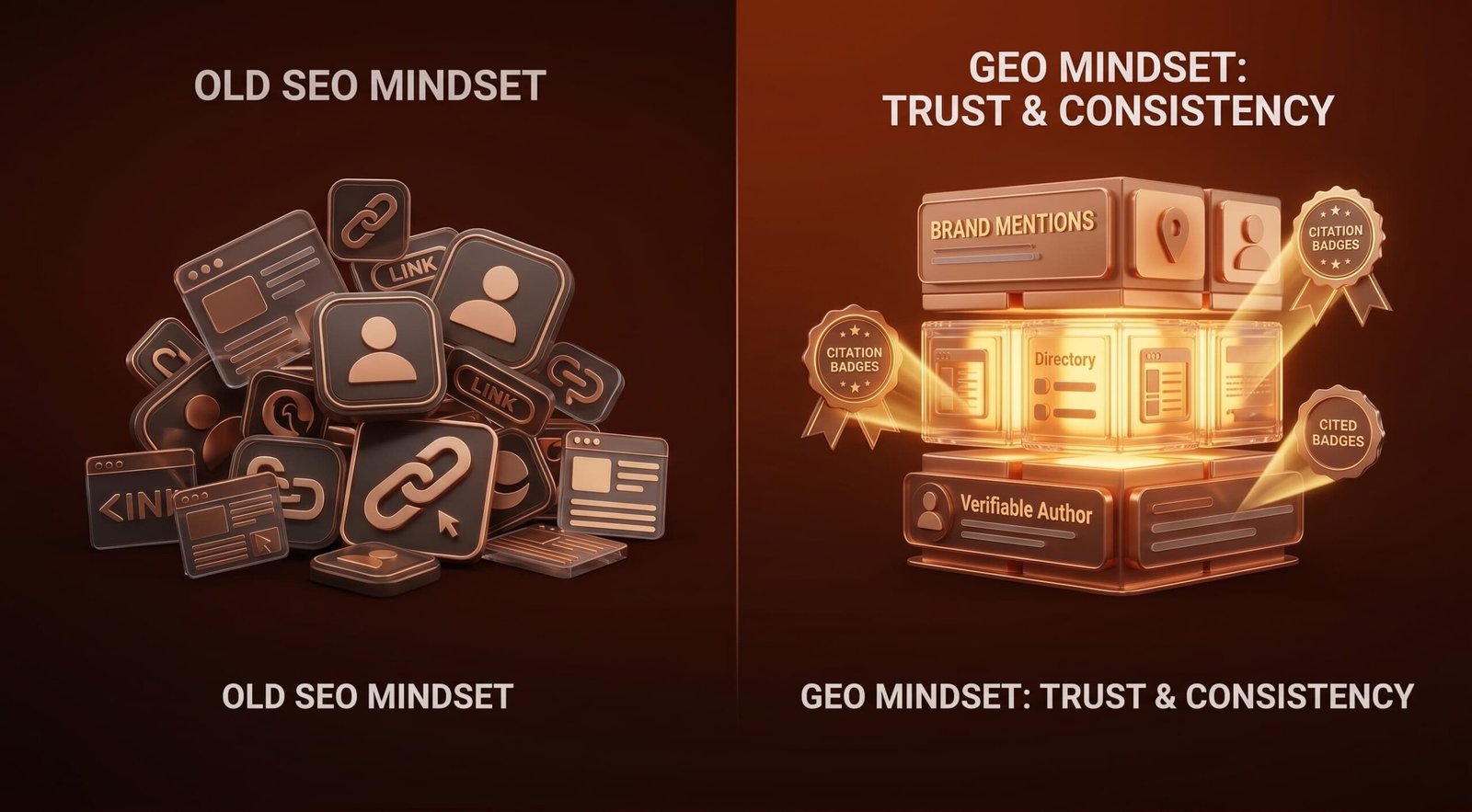
For years, “get mentioned by authoritative sites” meant chasing backlinks for ranking power. GEO reuses that instinct but for a different reason. AI engines treat consistent third-party mentions as corroboration — evidence that your business is real, active and trusted. A backlink still helps, but so does an unlinked mention in a reputable article, a genuine review, or an accurate directory listing. The goal is a coherent, trustworthy footprint across the web, not a pile of links. Quality and consistency beat volume every time.
How AEO fits your wider strategy
Getting cited by AI is one layer of a modern search strategy, not the whole thing. Classic SEO still earns clicks, structured data makes your content machine-readable, and an AI-agent-ready site lets agents act on your pages. If you are mapping this out for the first time, lean on strong SEO content writing for the foundations and what is webMCP for where it is heading. The businesses that treat these as one connected strategy — rather than chasing each trend separately — are the ones that compound their visibility over the year.
What to measure
| Signal | How to track it |
|---|---|
| AI referral traffic | Watch for referrals from chatgpt.com, perplexity.ai and similar in your analytics |
| Brand mentions in AI answers | Periodically ask ChatGPT and Perplexity your key questions and note who is cited |
| Classic rankings | Google Search Console — strong rankings correlate with citations |
| Schema coverage | Validate with a structured-data testing tool to confirm markup is read |
A 30-day quick-start plan
You do not have to do everything at once. Here is a realistic order that produces early wins:
- Week 1 — fix the base. Make sure your most important pages load fast and are indexable. If rankings are weak, start with a technical SEO audit before anything else.
- Week 2 — add answers and schema. Rewrite the opening of your top five pages as clean 40–60 word answers and add FAQ and Article structured data.
- Week 3 — build a cluster. Publish two or three connected posts around one theme so your site reads as an authority. Local businesses should pair this with dedicated local SEO services.
- Week 4 — build trust signals. Update your Google Business Profile, tidy directory listings, and pitch one guest article or earn one genuine review.
Keep this up month after month and citations compound. If you would rather combine it with paid reach while the organic side matures, weigh up professional Google Ads management, and get the foundations right with expert web design and development.
Here is how to get cited by ChatGPT: publish clear, factual, well-structured content, add Schema.org markup, open pages with a direct 40 to 60 word answer, earn mentions on trusted sites, and keep your brand details consistent everywhere. AI cites sources it can read easily and trust.
Frequently asked questions
How do I get cited by ChatGPT?
Here is how to get cited by ChatGPT: publish clear, factual, well-structured content, add Schema.org markup, open pages with a direct 40 to 60 word answer, earn mentions on trusted sites, and keep your brand details consistent everywhere. AI cites sources it can read easily and trust.
What is generative engine optimization (GEO)?
GEO is the practice of optimising your content and brand presence so generative AI tools like ChatGPT, Perplexity and Gemini recommend and cite you in their answers. It combines strong content, structured data and third-party trust signals.
How long does it take to get cited by AI?
It varies. Pages with strong answers and schema can be picked up within weeks, but building the authority and third-party mentions that make citations consistent usually takes a few months of steady work.
Does getting cited by AI bring real traffic?
Yes. Citations drive referral clicks from AI tools and, just as importantly, brand exposure at the exact moment someone is researching a decision, which often leads to direct visits later.
Do I need backlinks to be cited by AI?
Backlinks and third-party mentions help because they build the trust AI engines look for. They are not the only factor, but consistent mentions across reputable sites clearly improve your chances of being cited.
