
For twenty years the goal was simple: rank on page one of Google and earn the click. But the way people find answers has changed. A large share of searches now end inside an AI-generated answer, with no click at all. That is why AEO vs SEO has become one of the most important questions in digital marketing this year — and why getting the balance right decides whether your business stays visible.
This guide explains the difference between AEO and SEO in plain terms, shows where they overlap, and gives you a practical plan to do both without wasting effort.
Search engine optimization is the practice of improving your website so it ranks higher in traditional search results. It covers keywords, quality content, backlinks, site speed, mobile-friendliness and technical health. The goal is to appear as high as possible in the list of blue links so people click through to your site. The classic reference for this is the Moz Beginner’s Guide to SEO, and Google’s own Search Central documentation.
SEO is not going away. People still search, still click, and still buy from organic results. If your fundamentals are weak, no amount of AI optimisation will save you — which is why our post on why your website is not ranking on Google is still essential reading.
Answer engine optimization is the practice of structuring your content so AI answer engines select and cite it when they generate a response. Instead of competing for a rank position, you are competing to be the trusted source an AI quotes. Tools like ChatGPT, Perplexity and Google’s AI Overviews increasingly answer the question directly, and AEO is how you make sure your brand is inside that answer. We cover the fundamentals in our beginner’s guide to answer engine optimization.
The reason this matters now is scale. Google’s AI Overviews appear on a majority of searches, and ChatGPT serves hundreds of millions of users every month. Gartner has predicted a significant fall in traditional search volume as this behaviour spreads. If you are not optimised for answers, you are ceding that ground to competitors who are.
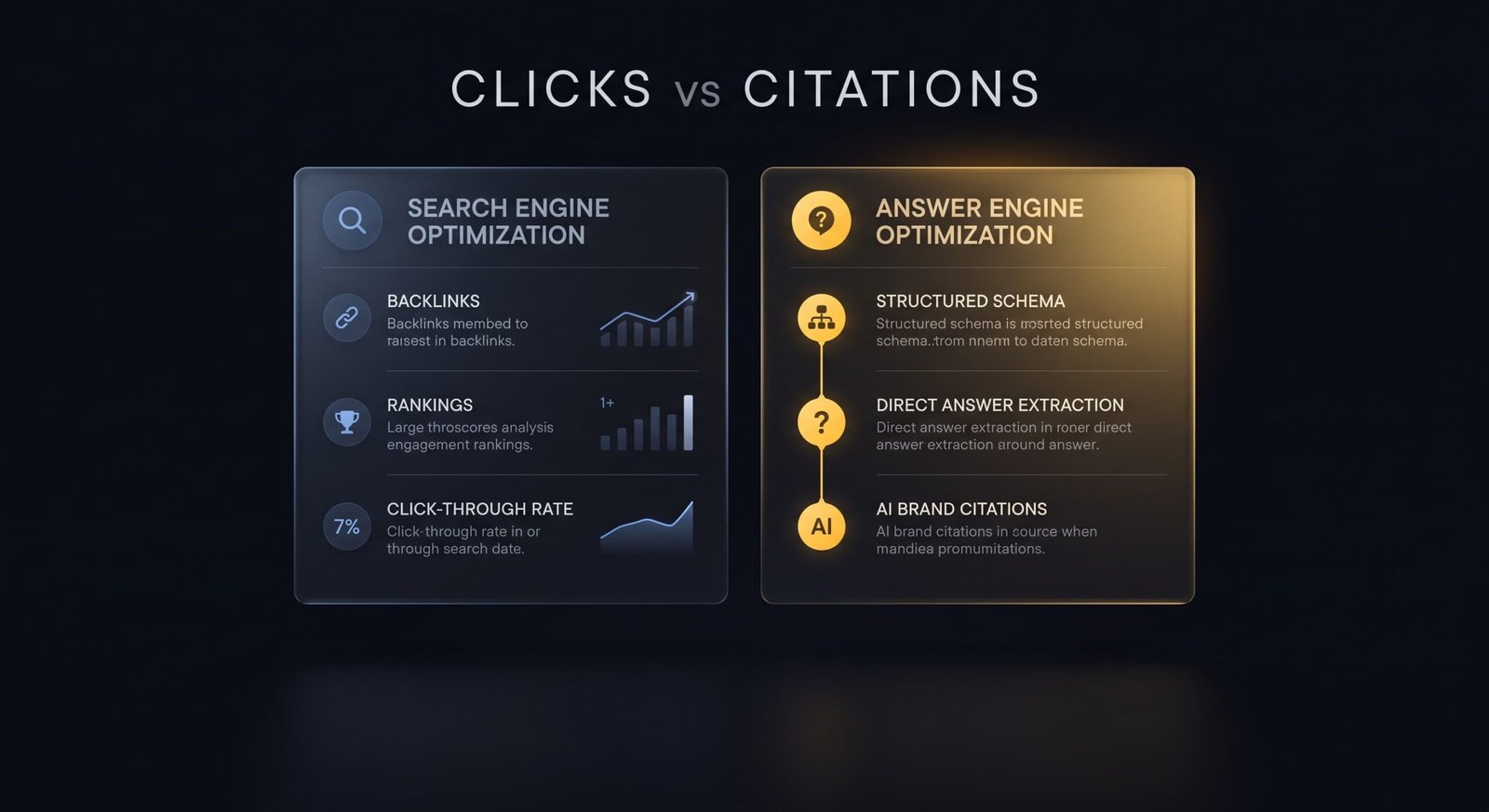
AEO vs SEO: the key differences
| Factor | SEO | AEO |
|---|---|---|
| Goal | Rank in the list of results | Be cited inside the AI answer |
| Where you appear | Google/Bing results pages | ChatGPT, Perplexity, AI Overviews, Gemini |
| Main currency | The click | The citation and brand mention |
| Content style | Comprehensive, keyword-targeted pages | Clear, quotable, self-contained answers |
| Key technical asset | Backlinks and site health | Structured data and clean facts |
| Success metric | Rankings, organic traffic | Citations, AI referral traffic, brand mentions |
Where AEO and SEO overlap
Here is the good news: AEO and SEO are not rivals. They share the same foundation. Both reward genuinely helpful content, fast clean websites, clear structure and trustworthy information. In fact, most content that gets cited by AI already ranks well in classic search, because AI engines draw heavily on the same signals — a point reinforced by Google’s guidance on helpful, people-first content.
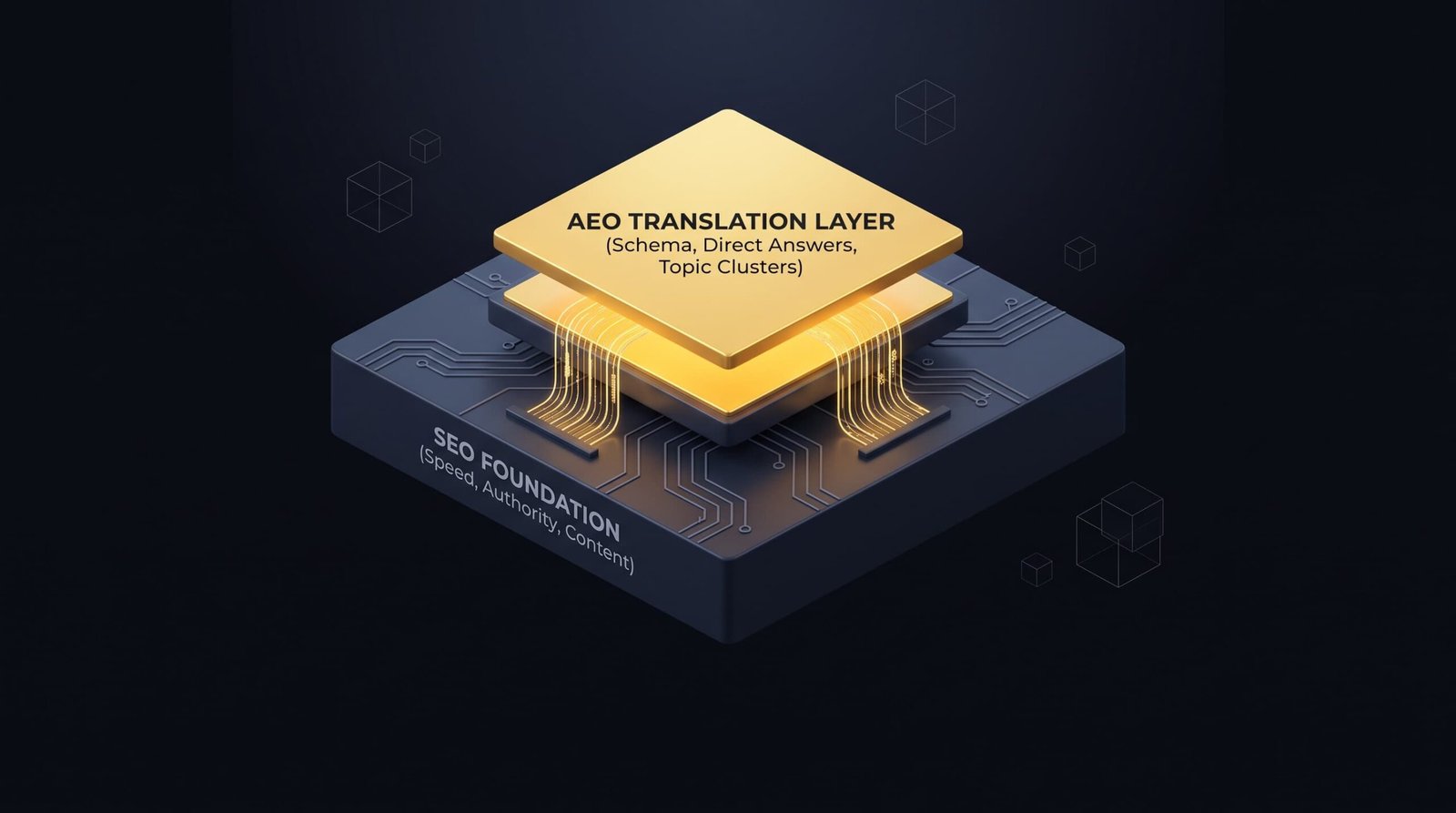
The difference is in the finishing. AEO adds a layer on top of solid SEO: answer-first formatting, question-based headings, comparison tables, and Schema.org structured data so machines can parse your meaning. Think of AEO as SEO with a translation layer for AI.
Is AEO replacing SEO?
No — and anyone telling you to abandon SEO is misreading the moment. SEO is the foundation AEO is built on. A page with no authority, poor content and no backlinks will not be cited by an AI any more than it will rank in Google. What is changing is the output layer: the same strong content now needs to serve two destinations — the results page and the AI answer. The smart play in 2026 is to treat them as one strategy with two goals.
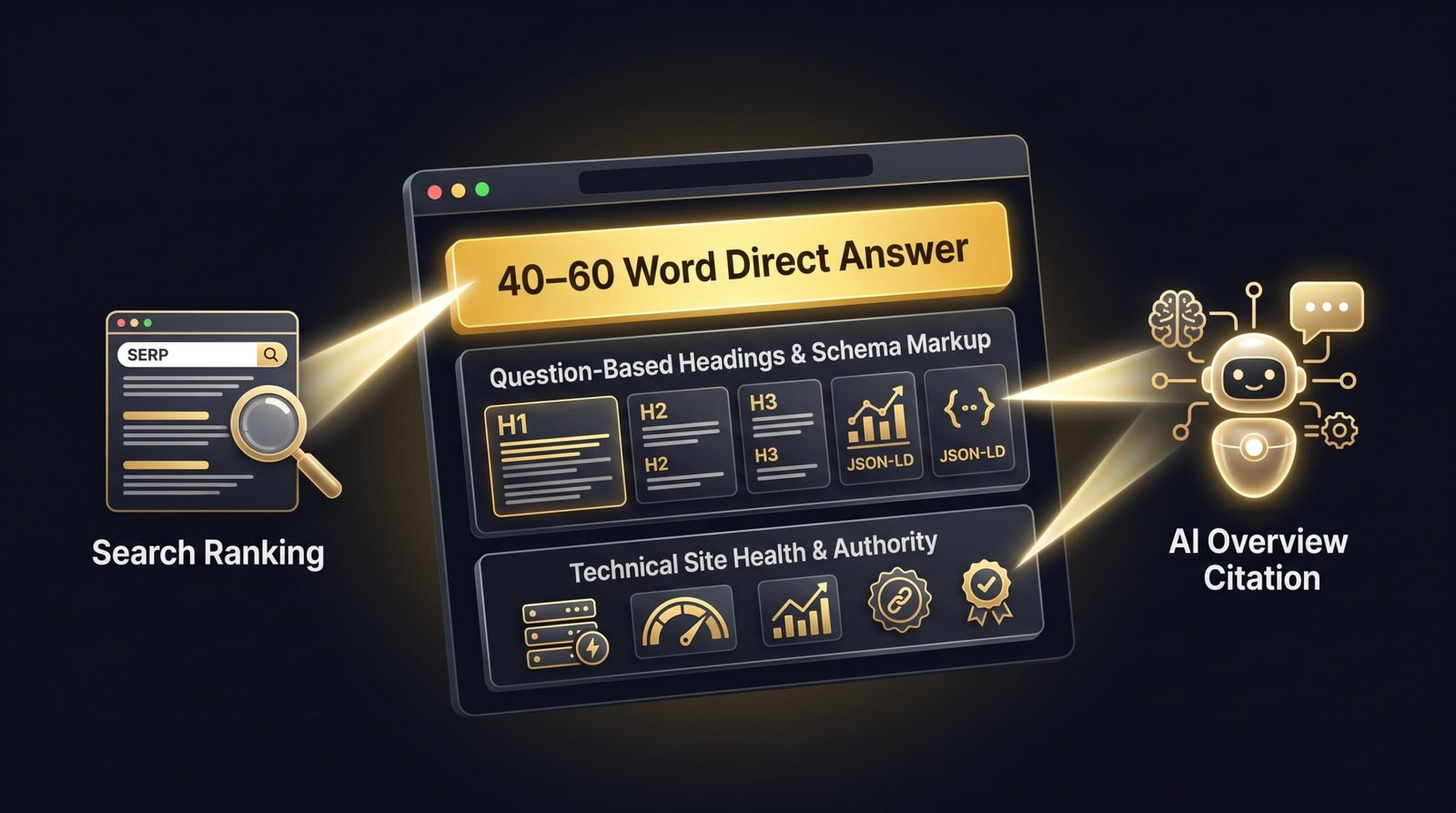
A real example: the same query in SEO and AEO
Say a potential customer wants to know “how much does a business website cost?” Watch how the two disciplines play out for the same question.
The SEO win: your in-depth pricing guide ranks third in Google. The searcher clicks, reads, and maybe fills in your contact form. You earned a visit and a chance to convert. This still happens millions of times a day, which is why SEO remains essential.
The AEO win: the same searcher instead asks ChatGPT or sees a Google AI Overview. The AI answers “a small business website typically costs between X and Y,” and cites your pricing guide as the source, with your brand name attached. The user never sees a results page — but they now associate your business with the answer, and a share of them will visit you directly. You captured mindshare at the exact moment of research.
Notice that the same page did both jobs. That is the whole point: you are not building two content libraries, you are finishing one library so it serves two destinations. Our website cost calculator is a good live example — it ranks, and it gives AI a clean, quotable answer.
Common mistakes brands make with AEO
- Chasing AEO while ignoring SEO fundamentals. If your site is slow, thin or untrusted, AI will not cite it. Fix the base first — our guide to why your website is not ranking covers the essentials.
- Burying the answer. If a reader (or an AI) has to scroll past 400 words of intro to reach the point, you have lost the citation. Lead with it.
- Skipping structured data. Schema is how machines confirm what your content means. Missing it is the single most common reason quotable content still goes uncited.
- Writing for keywords instead of questions. AI matches natural questions. Headings like “Pricing” lose to “How much does it cost?”
- Publishing one-off posts. Authority comes from clusters. A single article rarely earns trust; a connected set does.
How to measure AEO success
AEO needs slightly different metrics than classic SEO. Alongside rankings and organic traffic, watch for referral visits from AI tools such as chatgpt.com and perplexity.ai in your analytics, track whether your brand appears when you ask AI your key questions, and confirm your structured data is valid so machines can read it. Together these tell you whether you are winning citations, not just clicks.
How to do both: a practical 2026 checklist
- Keep your SEO fundamentals strong — quality content, fast site, good internal linking, and a healthy backlink profile.
- Lead every page with a 40–60 word answer that stands on its own, so AI can lift it cleanly.
- Use question-based headings that match how people actually ask.
- Add structured data — Organization, Article, and FAQ schema at minimum. Most sites still skip this; it is your edge.
- Include comparison tables and specific numbers — AI loves scannable, factual blocks.
- Build a topic cluster, not one-off posts, so your site reads as an authority. See how we structure this in making your website AI-agent ready and getting cited by ChatGPT.
- Support organic with paid where it makes sense — while your AEO footprint matures, compare the trade-offs in Google Ads vs SEO.
- Prepare for AI agents, not just answers — understand the shift in AI agents vs chatbots.
Want to see how the pieces connect for your own site? Our website platform picker and website cost calculator are examples of the answer-friendly, tool-led content that performs in both channels.
Not sure whether your content is winning clicks, citations, or neither? Devlet Tech runs combined SEO + AEO strategies built for how people search in 2026. Explore our AEO services → or book a free audit.
Frequently asked questions about AEO vs SEO
What is the difference between AEO and SEO?
SEO optimises your pages to rank in search results and earn clicks. AEO optimises your content to be quoted inside AI answers from tools like ChatGPT and Google AI Overviews. SEO wins the ranking; AEO wins the citation.
Is AEO replacing SEO in 2026?
No. AEO is built on top of SEO, not instead of it. Strong SEO fundamentals — quality content, authority and site health — are what allow your content to be cited by AI in the first place.
Do I need to do both AEO and SEO?
Yes. Traditional search still drives clicks and sales, while AI answers capture a fast-growing share of queries. Doing both ensures you stay visible wherever your audience looks.
What is the fastest way to start with AEO?
Open each page with a clear 40 to 60 word answer, use question-based headings, and add FAQ and Article structured data. These three changes make your existing content far easier for AI to cite.
Does AEO help my Google rankings too?
Often yes. The clear structure, strong answers and schema that AEO requires also improve relevance and rich-result eligibility in classic search, so the two reinforce each other.
