
The web design agency vs freelancer decision, reframed
Most people compare hourly rates and stop. That’s how they end up paying twice for the same website.
The rate is the smallest part of the decision. The real question is: what happens when something goes wrong? Because on a web project, something always does — a missed deadline, a bug after launch, a feature nobody scoped, a designer who goes quiet for two weeks.
With a freelancer, the answer to “what happens when something goes wrong” is entirely about that one person. Great ones handle it. But there’s no backup, no process, and no one to escalate to.
With an agency, there’s structure built specifically for when things go wrong — someone covers, someone manages, someone’s accountable to a contract.
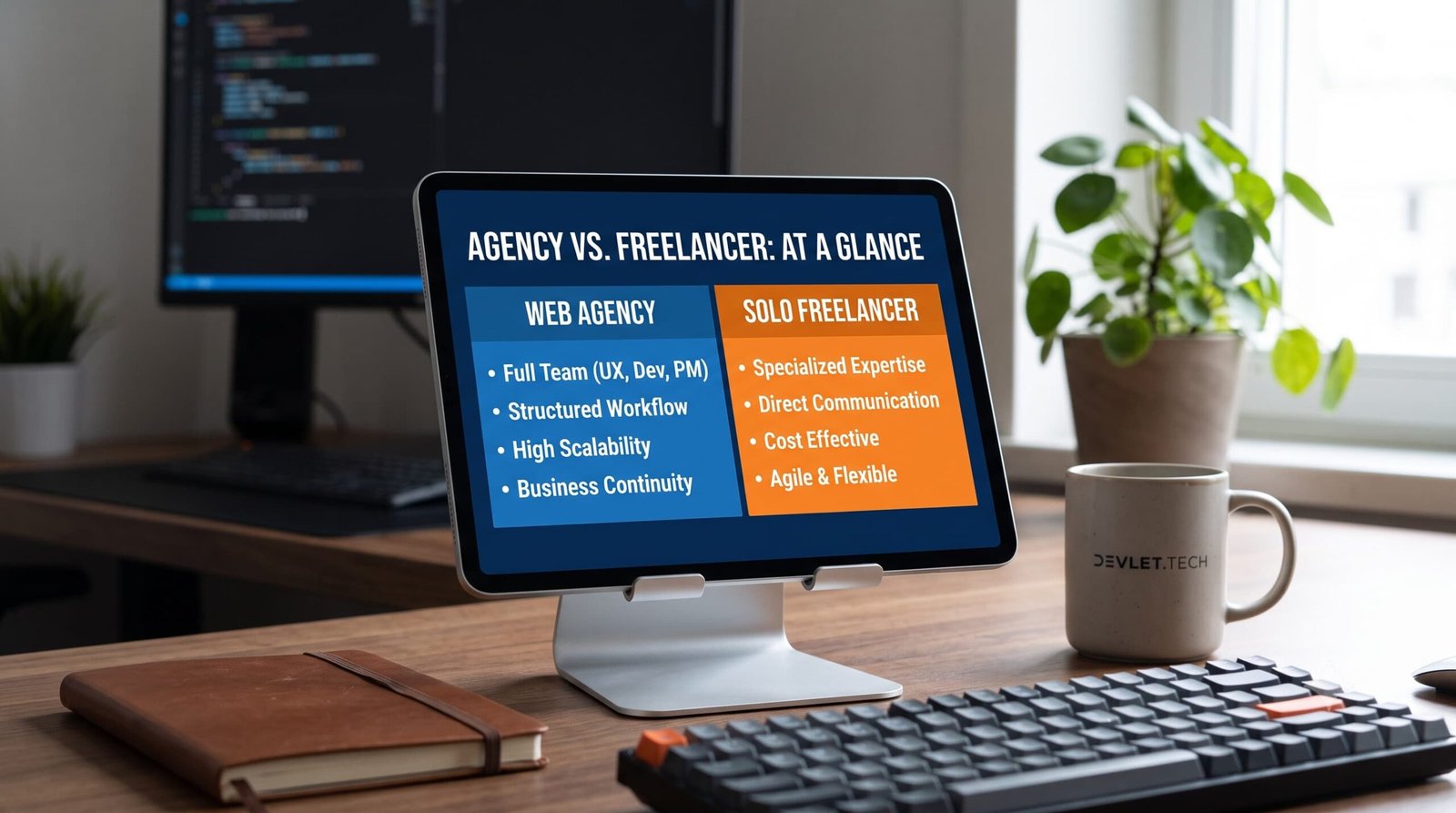
You’re not really choosing between two prices. You’re choosing how much you’re willing to bet on one person versus a system. That’s the web design agency vs freelancer question underneath the question.
Here are real 2026 ranges, not marketing numbers.
Web design agencies charge $5,000–$50,000+ for projects and provide complete teams — designers, developers, strategists — with accountability and faster timelines. Freelancers charge $2,000–$15,000 and offer lower costs with more personal attention but limited capacity and higher risk.
Hourly, the gap is just as wide. Freelance web developers run $30–$70/hour at junior to mid level, and $80–$150/hour for senior developers with seven or more years of experience. A watch-out on the low end: rates on platforms like Upwork tend to cluster around $25/hour because you’re competing in a race to the bottom, so quality swings widely and vetting eats your time.
One more number worth knowing before you decide on price alone: hiring an agency typically costs 50–100% more than a comparable freelancer project — but what you’re paying for is a team, a process, and accountability structures freelancers usually don’t have.
Most slow Elementor sites aren't slow because of Elementor. They're slow because of twelve plugins doing what three could do.
Where a freelancer genuinely wins
Cost, obviously — but that’s not the main one.
Direct communication. You talk to the person doing the work. No account manager relaying your feedback through three people. What you say is what the builder hears.
Personal investment. A good freelancer’s reputation rides on your project. Their next referral depends on your happiness. That’s real motivation an agency’s junior developer doesn’t always feel.
Flexibility. Freelancers bend on scope, timeline, and process in ways agencies with fixed methodologies can’t. Need something unusual? A freelancer can just… do it.
Speed on small projects. No kickoff meetings, no discovery phase, no internal handoffs. For a five-page site with a clear brief, a freelancer often ships before an agency’s finished onboarding you.
Freelancers are the right call when your scope is clear, your project is contained, and you can manage it yourself.
Where an agency genuinely wins
Nobody’s a single point of failure.
The freelancer who disappears mid-project is not a rare horror story — it’s the single most common way these go wrong. Illness, a bigger client, burnout, life. When it’s one person, their bad week is your dead project. An agency has other people. That redundancy is the product.
You get specialists, not a generalist.
A freelancer is usually strong at one thing and adequate at the rest. Great designer, okay developer. Or great developer, weak on design. An agency puts a real designer, a real developer, and often a strategist and copywriter on the same project. For anything complex, that specialization shows.
Process catches what individuals miss.
QA testing, cross-browser checks, accessibility, staging environments, code review. Agencies have these baked in. Most freelancers are testing in their own browser and hoping. It’s not that freelancers don’t care — it’s that one person can’t be the builder and the independent checker at the same time.
Accountability is contractual.
An agency is a company you can hold to an agreement. Post-launch support, warranty periods, someone answering the phone in six months. If a solo freelancer moves on, your support moves on with them.
Capacity to handle scope creep.
E-commerce with 100+ products, custom member portals, sophisticated CRM integrations, custom features specific to your business — all of these require agency-level resources. A freelancer hits a capacity ceiling; an agency adds a person.
The web design agency vs freelancer cost comparison
Rough ranges for a US-market build:
| WordPress (Elementor build) | WordPress (custom theme) | Fully custom | |
|---|---|---|---|
| Build | $2,000–$6,000 | $8,000–$25,000 | $15,000–$60,000+ |
| Timeline | 2–4 weeks | 6–12 weeks | 3–6 months |
| Admin panel | Included | Included | You build it ($3k–$10k) |
| SEO tooling | Plugin, ~$60/yr | Plugin, ~$60/yr | Built by hand ($2k–$5k) |
| Content edits | Your team, free | Your team, free | Only if you built the panel |
| Monthly upkeep | $50–$300 | $50–$300 | $500–$2,500 |
| Replacing your dev | A week | A week or two | A month, and pricier |
That last row deserves a minute of your attention. A custom application without a developer on retainer is a liability, not an asset. Dependencies age. Patches land. Versions get deprecated. If you can’t commit to that relationship indefinitely, don’t start it.
The cost nobody quotes you
Notice something else: there’s no clean line between “WordPress” and “custom.” There’s a ladder. Most businesses convinced they need the top rung actually need the middle one.
The real cost most people ignore
Here’s the frame that changes the whole decision.
Your website isn’t a design expense. It’s a revenue channel. If your site gets 1,000 visitors a month at a 1% conversion rate versus the 3% you could get with better design, you’re losing 20 potential customers a month. At $5,000 average customer value, that’s $100,000 a year.
Put that next to the price tags. The gap between a $3,000 freelancer and a $15,000 agency is $12,000. If getting it wrong costs you $100,000 a year in lost conversions, the $12,000 question isn’t “which is cheaper” — it’s “which is more likely to get it right.” Sometimes that’s the freelancer. Sometimes it’s the agency. But price alone is the wrong lens.
The middle path most people don't consider
There’s a third option nobody in this debate mentions because it doesn’t fit the two-sided framing: a small, senior agency, or a freelancer with a vetted network.
Small agencies give you agency structure — backup, process, accountability — without the big-agency overhead, layered account management, or the junior developer doing your actual build while the senior name closed the sale. You often talk directly to the people doing the work, freelancer-style, but with a team behind them.
On the other side, some experienced freelancers run a trusted bench — a designer they always work with, a developer they trust. You get freelancer pricing and directness with some of the redundancy that makes agencies safer. Ask any freelancer you’re considering: what happens if you get sick mid-project? Their answer tells you whether they’ve thought about the single-point-of-failure problem or whether you’ll discover it the hard way.
This middle path is where a lot of the best value sits, and it’s exactly the gap a full-service web design and development team is built to fill — the structure of an agency, the directness of a freelancer.
How to choose without regretting it
Skip the rate. Ask these instead:
How complex is it, really? Brochure site with clear scope → freelancer’s fine. E-commerce, integrations, custom functionality → agency territory.
What does it cost you if it’s late or broken? Low stakes → freelancer risk is acceptable. High stakes, revenue riding on it → pay for redundancy.
Can you manage the project yourself? Freelancers need a client who can give clear direction and make decisions. Agencies bring project management. If you don’t have time to steer, that PM is worth paying for.
Do you need one thing or several? Just design → freelancer. Design plus development plus copy plus strategy plus SEO → coordinating four freelancers is a second job; an agency coordinates internally.
What happens in six months? If you’ll need ongoing support, updates, and someone who remembers how the site was built, an agency relationship outlasts a freelancer who’s moved to other clients.
If you’re building on WordPress either way, the platform decisions matter as much as who builds it — worth reading WordPress vs custom development and Elementor vs custom theme before you brief anyone.
Frequently asked questions
Is it cheaper to hire a freelancer or an agency for web design?
Yes, for most of them. WordPress handles content-driven business sites — services, case studies, blogs, lead-gen — better and cheaper than custom, mainly because your team can edit it and the SEO tooling is mature and free. It becomes the wrong choice when your site is really an application with users, workflows, and dashboards.
What's the biggest risk of hiring a freelancer?
When your logic doesn’t exist as a plugin, when speed is a proven business requirement rather than a preference, or when you’re building something that’s genuinely an application. “It feels limiting” isn’t a reason. Neither is “WordPress seems unprofessional.”
When is a web design agency worth the extra cost?
WordPress runs $2,000–$25,000 depending on whether you use a page builder or a custom theme. Fully custom starts near $15,000 and climbs past $60,000. The bigger gap is ongoing: WordPress upkeep is $50–$300/month, custom is $500–$2,500 and requires a developer on retainer.
Do agencies really deliver better quality than freelancers?
Three genuine ones: it slows down if you let plugins accumulate, every plugin is a maintenance bet, and it fights you on real application logic. The claims that it can’t scale, isn’t secure, or is bad for SEO are implementation problems dressed up as platform problems.
Can I get agency quality at freelancer prices?
Yes, and it’s usually the smart sequence — prove demand cheaply first. The catch: page-builder content doesn’t migrate cleanly, so if you expect to move, build on a custom theme rather than a builder from day one.
How do I compare quotes fairly between a freelancer and an agency?
No. Google doesn’t care what built the page. WordPress has a practical advantage because sitemaps, schema, and meta management are free and mature. On custom you build all of it by hand — doable, and routinely under-budgeted.
