Is SEO Worth It for Small Business in 2026? An Honest Answer
Is SEO worth it for small business? Honest 2026 answer with real ROI data — plus when it’s genuinely a waste of money and when to run ads instead.


Is SEO worth it for small business? Honest 2026 answer with real ROI data — plus when it’s genuinely a waste of money and when to run ads instead.

Web design agency vs freelancer: it’s about risk, not price. Real 2026 cost ranges, the single-point-of-failure problem, and the middle path nobody mentions.

WordPress vs custom development: one question decides it. Real cost ranges ($2k–$60k+), the admin panel nobody budgets, and which limitations are actually real.
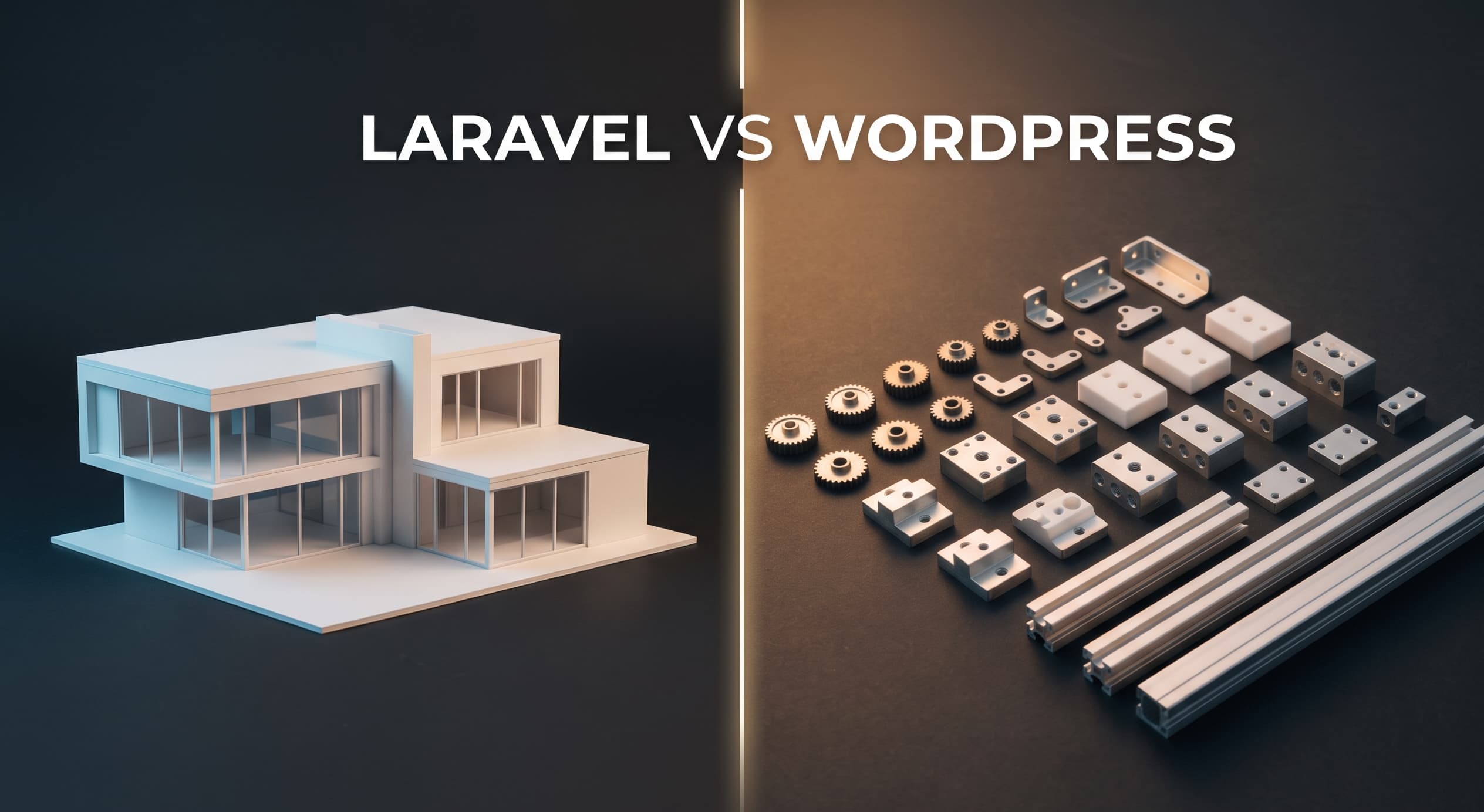
Laravel vs WordPress: How to Pick the Right Backend (Without Regretting It in Year Two) Laravel vs WordPress comes down to one question: is your site mostly content or mostly logic? Muhammad Umer Web Development Lead · Jul 16, 2026 · 8 min read Short answer Pick WordPress if your site is mostly content — pages, posts, services, a blog your marketing team updates. Pick Laravel if your site is mostly logic — user accounts, custom workflows, dashboards, calculations, things that don’t exist as a plugin. WordPress builds run $2,000–$8,000 in 4–6 weeks. Laravel builds run $15,000–$60,000+ over 3–6 months. If you’re genuinely torn between them, you almost certainly want WordPress — because the people who need Laravel usually already know it. The one question that decides it Write down what your site actually does. Then sort every item into two buckets: Bucket A — Content. Pages. Blog posts. Service descriptions. A team page. Case studies. Contact forms. Anything where the site’s job is to show something. Bucket B — Logic. Users log in and see different things. Something gets calculated. Data flows between systems. There’s a workflow with states. Someone has a dashboard. Now look at the split. 90% Bucket A? WordPress. Don’t overthink it. Mostly Bucket B? Laravel. Genuinely both? Keep reading — there’s a third answer. That’s it. That’s the decision. Everything below is just detail on why. Where WordPress actually wins Your team can edit it without calling you. This is underrated to the point of absurdity. WordPress ships with an admin panel that a marketing coordinator can use on day one. In Laravel, there is no admin panel — you build one, or you bolt on a tool to generate one. That’s real money and real time, and it’s the single most common thing that blindsides people who choose Laravel for a content site. The ecosystem already solved your problem. Contact forms, SEO metadata, caching, backups, multilingual, memberships, e-commerce — all exist, all mature, all cheap. In Laravel you write it or you find a package and maintain the integration yourself. Most slow Elementor sites aren’t slow because of Elementor. They’re slow because of twelve plugins doing what three could do. SEO infrastructure comes free. Rank Math or Yoast gives you sitemaps, schema, canonical tags, meta management, breadcrumbs, redirects — configured in an afternoon. On Laravel you build every one of those by hand. They’re not hard individually. There are just a lot of them, and teams forget half until traffic doesn’t show up. It’s cheaper to hire for. WordPress developers are everywhere. Good Laravel developers cost meaningfully more and are harder to replace. If your dev disappears, WordPress means a week of searching. Laravel can mean a month. Where Laravel actually wins When your logic doesn’t exist as a plugin. Multi-tenant SaaS. A marketplace with escrow. A booking engine with real availability rules and conflict resolution. An internal tool that talks to three APIs and your ERP. Try forcing these into WordPress and you end up with a Frankenstein of six plugins fighting each other, plus custom code holding it together, plus a rebuild in two years. When you actually own the code. No plugin author abandoning a critical dependency. No breaking change from an update you didn’t ask for. No mystery about why something behaves the way it does. You wrote it, so it does what you wrote. Security surface. Most WordPress hacks aren’t WordPress — they’re a plugin nobody updated. Laravel has a much smaller attack surface simply because there’s less third-party code. But be honest about the flip side: WordPress security is maintained by other people. Laravel security is maintained by you, forever. That’s not automatically a win, it’s a transfer of responsibility. Performance ceiling. A tuned Laravel app will beat a tuned WordPress site. Not by a little, either, once you’re past simple pages. But most sites never get near the ceiling where this matters — and a slow site is usually slow for boring reasons, not framework reasons. The honest cost picture Rough ranges for a US-market build: WordPress Laravel Build $2,000–$8,000 $15,000–$60,000+ Timeline 4–6 weeks 3–6 months Admin panel Included You build it ($3k–$10k) SEO tooling Plugin, ~$60/yr Built by hand ($2k–$5k) Content edits Your team, free Your team, if you built the panel Monthly upkeep $50–$300 $500–$2,500 (needs an actual dev) Replacing your dev A week A month, and more expensive Look at that last row for a minute. A Laravel app without a developer on retainer is a liability, not an asset. Dependencies age. Security patches land. PHP versions get deprecated. If you can’t commit to that ongoing relationship, you shouldn’t start. WordPress rots more gracefully. Neglect it for a year and you have an outdated site with some risk. Neglect a Laravel app for a year and you may have something nobody wants to touch. The cost nobody quotes you WordPress developers are everywhere. Good Laravel developers cost meaningfully more and are harder to replace. If your dev disappears, WordPress means a week of searching. Laravel can mean a month The third answer nobody offers you Headless WordPress + a custom frontend. WordPress runs behind the scenes purely as a content store — your team edits in the admin they already know. A custom frontend (React, Next.js, or a Laravel app) consumes it via API and renders whatever you want, however fast you want. You get: familiar editing, custom application logic, and a performance ceiling that’s nowhere near WordPress’s. You pay: two systems instead of one, more moving parts, and it costs more than plain WordPress. This is genuinely the right answer more often than the industry admits — specifically when you have a marketing team that publishes constantly and real application logic. Most agencies won’t propose it because it’s harder to scope and sell than “we’ll build you a WordPress site.” The mistakes we see most Choosing Laravel because WordPress feels unserious. This is an ego decision dressed up as a technical one.
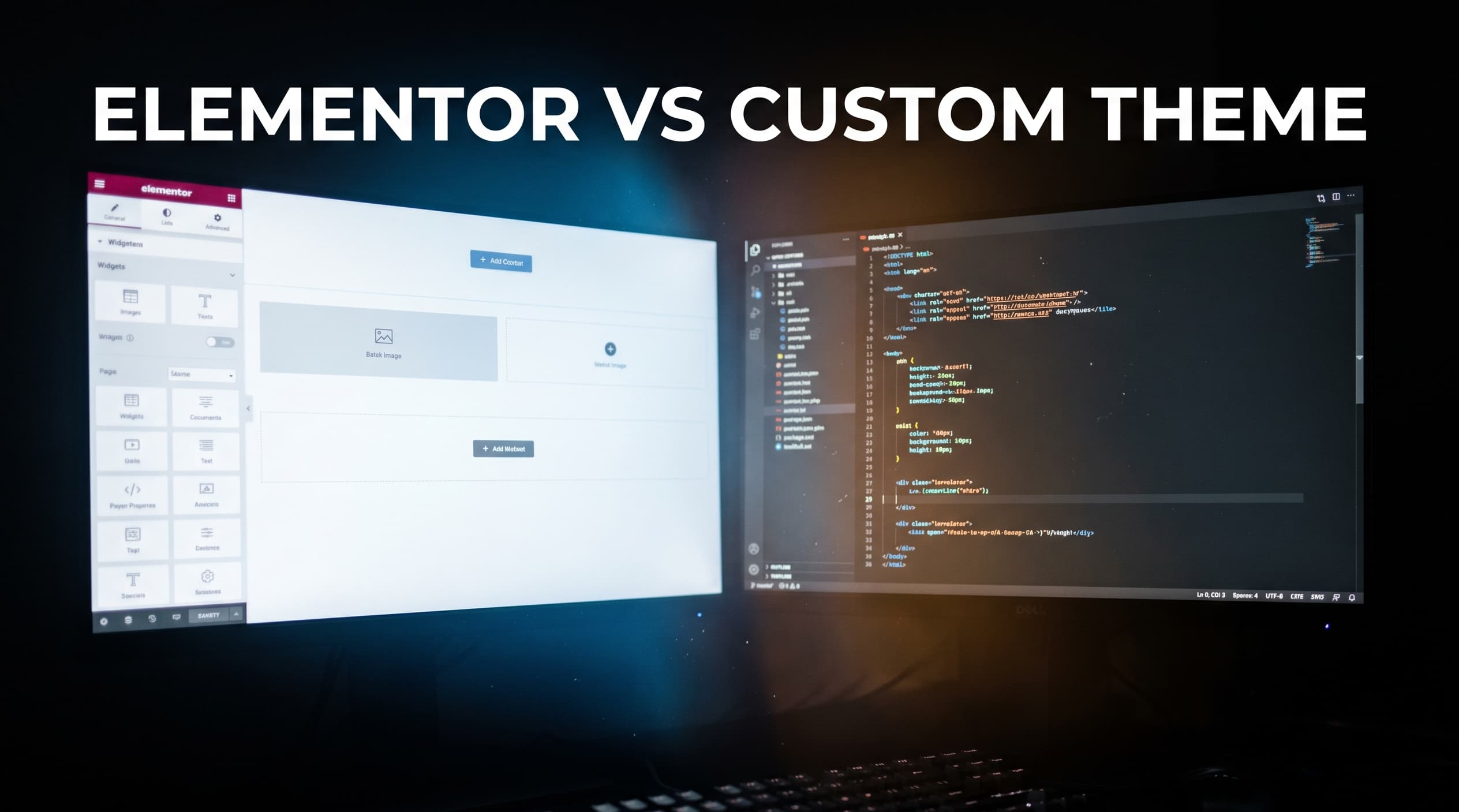
Web Development Elementor vs Custom Theme: Speed, Cost, and the Long-Term Pain Nobody Warns You About Most articles on this are written by people selling one of them. We ship both — so let’s just be straight about the trade-offs. Muhammad Umer Web Development Lead · Jul 16, 2026 · 8 min read Short answer Elementor vs custom theme comes down to one question. Elementor is the right call when you need a site live in weeks, your team will edit it themselves, and the design is fairly conventional. A custom theme wins when page speed is a business requirement, your layouts are genuinely unusual, or you’re planning to still be on this site in five years. Elementor builds run $2,000–$6,000 in 2–4 weeks. Custom themes run $8,000–$25,000 over 6–12 weeks. What people actually mean when they ask this Nine times out of ten, the real question underneath is one of these: “Will Elementor wreck my page speed?” “Am I getting ripped off if someone quotes me $15k for a custom build?” “I already have an Elementor site and it’s slow. Do I rebuild?” Those are three different questions with three different answers. We’ll get to all of them. The speed question Yes, Elementor adds weight. No, it’s not the death sentence people claim. Elementor wraps your content in nested containers to handle its layout system. A section becomes a container, inside a container, inside a column, inside a widget wrapper. That’s real DOM bloat — maybe 200–400KB before your own content loads. A well-built custom theme carries almost none of that. The markup is what you wrote and nothing else. But here’s the part nobody says out loud: most slow Elementor sites aren’t slow because of Elementor. They’re slow because of: Twelve plugins doing what three could do Hero images uploaded at 4000px wide and displayed at 600px A slider plugin loading 300KB of JavaScript for one banner Cheap shared hosting with a 900ms server response time Four Google Font families, thirteen weights Most slow Elementor sites aren’t slow because of Elementor. They’re slow because of twelve plugins doing what three could do. Fix those and a lot of Elementor sites hit green Core Web Vitals. We’ve done it. It’s not magic — it’s boring cleanup work. Where Elementor genuinely bites is INP (Interaction to Next Paint). All those nested containers plus Elementor’s JS mean the main thread has more to chew through when someone taps a menu or opens an accordion. On a mid-range Android phone over 4G, that gap between Elementor and custom is real and it’s measurable. So: if you need a fast-ish site, Elementor is fine with discipline. If you need a genuinely fast site — because you’re running paid traffic and every 100ms costs you conversions — custom. The cost question Rough ranges for a US-market build: Elementor Custom theme Build cost $2,000–$6,000 $8,000–$25,000 Timeline 2–4 weeks 6–12 weeks Content edits You, free Developer, hourly New templates You, free $500–$2,000 each Notice the last two rows. That’s where the math flips. If your marketing team publishes two landing pages a month, Elementor pays for itself in the first quarter. If your site is eight pages that never change, custom’s higher upfront cost stops mattering by year two — and you stop paying for a page builder license and its plugin ecosystem forever. The cost nobody quotes you The cost nobody quotes you: Elementor sites tend to accumulate. Someone adds a popup plugin. Then a form plugin. Then a slider. Three years in, you’ve got 28 plugins, a 4MB homepage, and a rebuild quote that costs more than the original build. That’s not Elementor’s fault exactly — but Elementor makes it easy, and easy things happen. The lock-in nobody warns you about This is the one that actually matters long-term, and it barely gets mentioned. Elementor stores your page content as serialized JSON inside a WordPress meta field. Not as clean post content. As a blob. What that means in practice: deactivate Elementor and your pages turn into shortcode soup. Not “look a bit off.” Unreadable. If you ever want to migrate to a different builder, a headless setup, or a custom theme, you’re rebuilding every page by hand. There’s no clean export. A custom theme stores content as, well, content. Migrate whenever you want. Is that a dealbreaker? For a local service business with a 10-page brochure site — no, you’ll never migrate anyway. For a company that might go headless in three years, or get acquired, or scale to 400 pages — that’s a five-figure problem waiting quietly in the basement. The SEO question Straight up: Elementor doesn’t hurt your rankings. Google doesn’t know or care what built the page. What Google cares about is what the page delivers — speed, structure, whether the content answers the query. Elementor can produce excellent semantic HTML if whoever built it used proper heading widgets instead of styling a div to look like an H2. It can also produce garbage. Same as custom. Two Elementor-specific things worth watching: Heading hierarchy. Elementor makes it trivially easy to have four H1s on a page because someone liked how the H1 preset looked. Check yours. Mobile Core Web Vitals. Elementor’s mobile output is where the DOM weight shows up worst — and mobile is where AI Overviews already push organic results further down the page. You don’t have room to also be slow. So which one? Pick Elementor if Budget under $6k You need it live this quarter Your team will edit content themselves Design is conventional — hero, services grid, testimonials, CTA Nobody on your team writes code Pick Elementor if Speed is a business requirement, not a nice-to-have Your design has genuinely custom interactions You’re running serious paid traffic where CVR moves real money You’re planning headless, an app, or heavy integrations later Long-term ownership matters more than short-term flexibility The hybrid worth knowing about: custom theme for the templated pages that carry your traffic — homepage, service pages, blog —
