The single biggest factor isn’t the software or the page count. It’s who does the work.
| Platform approach | Typical build cost | What you're getting |
|---|---|---|
| Page builder (Elementor) | $2,000–$6,000 | Fast, you can edit it yourself |
| Custom WordPress theme | $8,000–$25,000 | Faster site, cleaner code, still editable |
| Shopify | $3,000–$20,000 | Selling handled end to end |
| Fully custom build | $15,000–$60,000+ | An application, not a website |
For context on where most buyers land: <cite index=”17-1″>61% of small business buyers spent under $10,000 on their most recent website project in 2026, down from 68% in 2023 as buyers demand more custom design and conversion-focused features.</cite> So budgets are rising — but most small businesses still sit under the $10k line.
This is the part that separates a good decision from an expensive regret.
A $12,000 small business site with modest ongoing support costs $23,000 to $42,000 across three years — a multiplier of 2.0 to 3.4x the initial build depending on ongoing investment level.
Read that again. The build is a third of the real cost. Where the rest goes:
- Hosting and domain — $60–$1,400/year depending on setup
- Maintenance and security — basic care plans run $50–$150/month covering hosting, backups, and software updates; hands-on plans with real support, performance work, and security monitoring run $150–$500/month.
- Content and updates — new pages, blog posts, photography
- Iteration — reserve 30 to 45 percent of your first-year budget for post-launch iteration, content production, and measurement improvements.
Any agency quoting you a build price without discussing year two and three is either inexperienced or hoping you won’t ask.
What actually drives the price up
Six things move the number more than anything else:
- Page count. A five-page site costs far less than a 20-page one — more copy, more layouts, more decisions.
- Template vs custom design. Template-based is cheaper. Custom is designed around your brand and audience, and costs accordingly.
- Who writes the copy. Most owners forget this line entirely. Words are what convert; design just gets attention.
- Functionality. Booking systems, member logins, payment processing, CRM integrations — each one adds real hours.
- E-commerce. Product pages, checkout, inventory. This is where budgets jump fastest.
- SEO foundation. Not decoration — it’s whether Google can understand and rank the site at all.
The platform choice inside the price
Two identical-looking quotes can be built completely differently, and that changes what you’re actually buying.
| Platform approach | Typical build cost | What you're getting |
|---|---|---|
| Page builder (Elementor) | $2,000–$6,000 | Fast, you can edit it yourself |
| Custom WordPress theme | $8,000–$25,000 | Faster site, cleaner code, still editable |
| Shopify | $3,000–$20,000 | Selling handled end to end |
| Fully custom build | $15,000–$60,000+ | An application, not a website |
If you’re weighing these, we’ve written the detail elsewhere: Elementor vs custom theme covers the WordPress fork, WordPress vs Shopify vs Webflow covers the platform choice, and WordPress vs custom development covers when you genuinely need custom.
The cost nobody quotes you
Notice something else: there’s no clean line between “WordPress” and “custom.” There’s a ladder. Most businesses convinced they need the top rung actually need the middle one.
How to know what YOU should spend
Skip the average. Ask these four questions instead:
1. What’s the site’s job? A brochure site that proves you exist belongs at the low end. A site that generates your leads justifies far more — as long as you can measure what it returns.
2. What’s a customer worth to you? If one client is worth $5,000, a $10,000 site paying back two customers is trivially worth it. If your average sale is $50, the math is completely different.
3. Who’s maintaining it? If nobody on your team can update the site, you’re paying an agency monthly forever. Budget it now, not in month four.
4. Can you afford year two? Take your build quote and multiply by 2.5. If that three-year number is affordable, proceed. If it isn’t, scope smaller now rather than abandoning a half-finished site later.
The budget traps that cost the most
- Cheap hosting. Migrating off bad hosting later costs $700–$6,000 to fix — far more than choosing decent hosting from the start.
- Skipping mobile optimization. Roughly 60% of web traffic is mobile. A desktop-only site loses most of its visitors.
- Paying for unused plugins. They accumulate, cost money, and slow the site down.
- Choosing on price alone. The cheapest quote and the most expensive quote are frequently pricing two completely different amounts of work. Compare an agency and a freelancer properly before assuming the cheaper one is cheaper.
- No SEO foundation. A beautiful site nobody finds is an expensive business card.
The honest bottom line
Most small businesses should budget $3,000–$10,000 for a professional website and plan for $2,500–$10,000 more across the following two years. That’s the real number.
Spend less than $3,000 and you’re usually getting a template with your logo on it — which is fine if the site’s job is just to exist. Spend more than $15,000 and you should be getting genuine custom functionality, not just nicer design.
The businesses that regret their website spend almost never overpaid on the build. They underpaid on the thinking — bought a site with no clear job, no plan for updates, and no way to measure whether it worked. Decide what the site must do first. The price follows from that.
If you want a straight answer on what your specific project should cost, tell us what the site needs to do — we’ll give you a real range, including when the honest answer is “spend less than you were planning.”
Frequently asked questions
How much does a website cost for a small business in 2026?
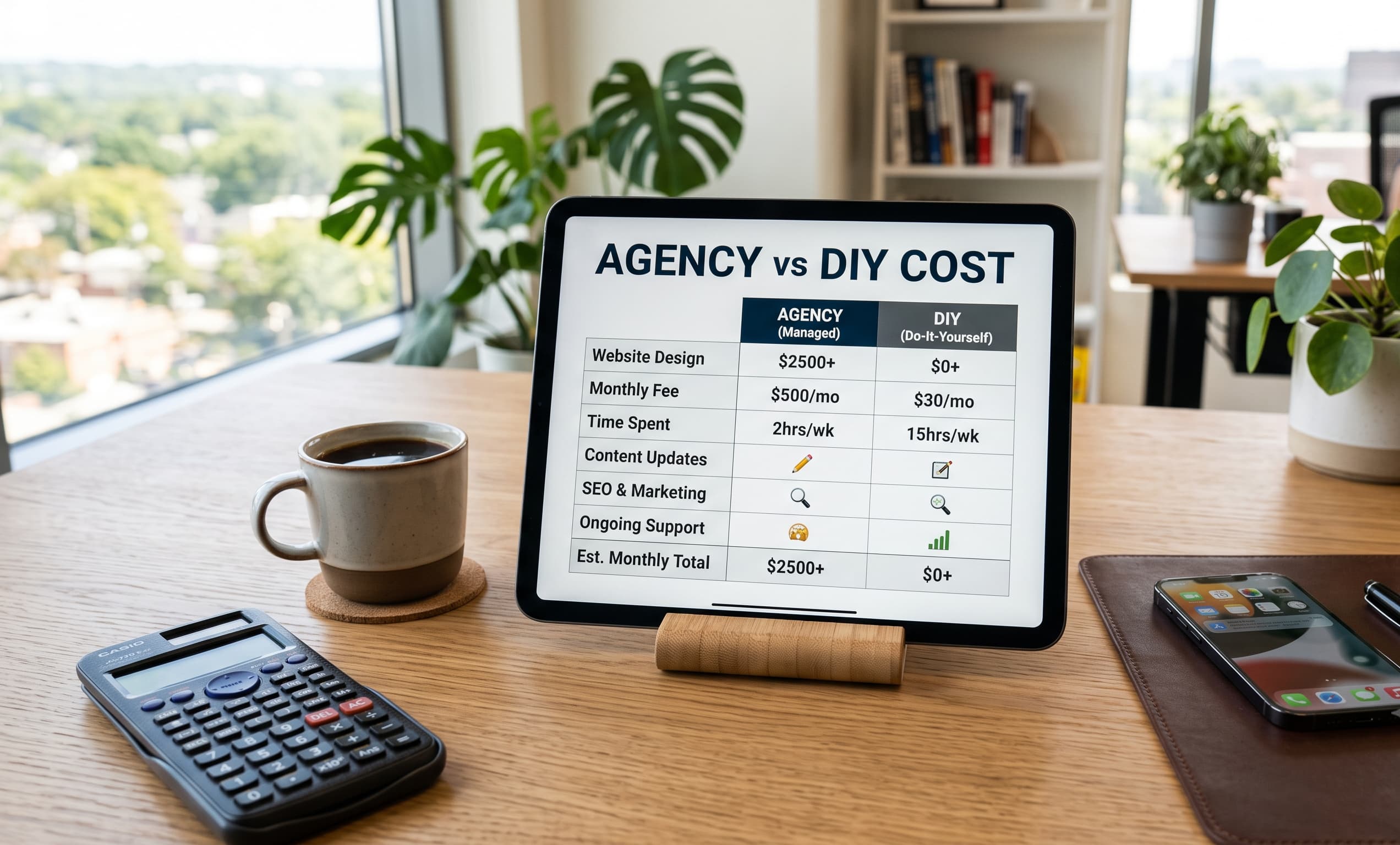
Most small businesses spend $3,000–$10,000 for a professional build, plus $50–$400 per month ongoing. DIY builders cost $20–$99/month, freelancers $500–$8,000, and agencies $5,000–$35,000+. The biggest price driver isn’t the software — it’s who does the work and how custom the design is.
Is it cheaper to build a website myself?
Upfront, yes — DIY builders run $200–$600 per year versus thousands for a professional build. But you’re paying with your time, and DIY sites typically underperform on speed, SEO, and conversion. It’s a good fit for testing an idea, and a poor fit for a site that needs to generate leads.
What are the ongoing costs of a small business website?
Expect $50–$400 per month, or roughly $1,000–$6,000 per year. That covers hosting, domain, security, backups, plugin updates, and content changes. Basic automated care plans run $50–$150/month; hands-on support with performance and security monitoring runs $150–$500/month.
Why do website quotes vary so much?
Because “a website” means completely different amounts of work. One quote may include copywriting, SEO setup, custom design, and three months of support; another may be a template with your content pasted in. Always compare scope — page count, functionality, content, SEO, and post-launch support — not just the number.
How much should I budget for a website over three years?
Multiply your build quote by roughly 2.5. A $12,000 site typically costs $23,000–$42,000 across three years once maintenance, hosting, content, and iteration are included. If that three-year figure isn’t affordable, scope the build smaller rather than abandoning it half-finished.
Is an expensive website worth it for a small business?
It depends entirely on the site’s job. If your website generates leads and one customer is worth thousands, a $10,000 site that converts well pays for itself quickly. If it’s a brochure that simply proves you exist, spending $20,000 is hard to justify. Match the spend to what the site actually has to earn.